
he landscape of digital asset taxation in the United States has officially changed. If you have been trading, holding, or spending cryptocurrency, the days of relying on an honor system or complex, unstandardized tax software alone are coming to a close. Welcome to the era of IRS Form 1099-DA.
For years, the Internal Revenue Service (IRS) struggled to bridge the “tax gap”—the difference between taxes owed and taxes paid—largely fueled by unreported cryptocurrency transactions. Now, the government has finalized its regulatory framework, and beginning with the 2025 tax year (reported in 2026), cryptocurrency brokers, centralized exchanges, and even some real estate professionals are mandated to report user transactions directly to the IRS.
This comprehensive, 2000+ word guide is designed to help US-based crypto investors navigate the new regulatory environment, understand exactly what Form 1099-DA is, and optimize their tax strategies legally before the IRS comes knocking.
What is IRS Form 1099-DA?
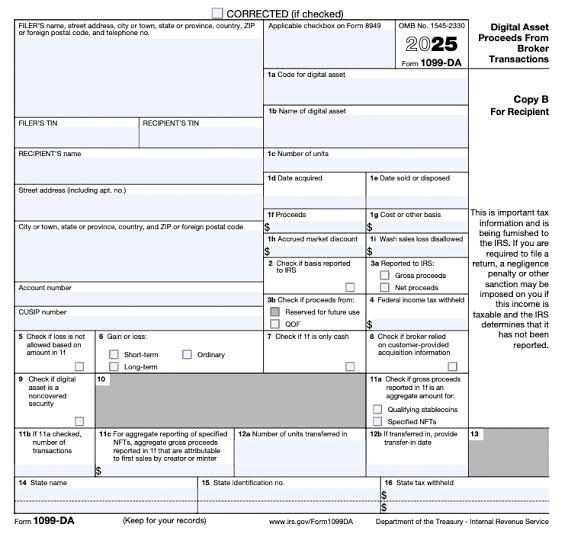
Form 1099-DA (Digital Asset Proceeds from Broker Transactions) is a standardized tax form created by the Internal Revenue Service. Its primary purpose is to report gross proceeds—and eventually the cost basis—from the sale or exchange of digital assets.
If you trade traditional stocks, you are likely familiar with Form 1099-B, which your brokerage sends you every February detailing your capital gains and losses. Form 1099-DA is the exact equivalent, but specifically tailored for cryptocurrencies, stablecoins, and Non-Fungible Tokens (NFTs).
The IRS defines a digital asset as any digital representation of value recorded on a cryptographically secured distributed ledger (like a blockchain). Because the IRS classifies cryptocurrency as property rather than currency, every time you sell, trade, or dispose of crypto, you trigger a taxable event. Form 1099-DA is the mechanism that ensures the IRS knows exactly when those taxable events occur.
Why Was This Form Created?
Historically, crypto exchanges like Coinbase or Kraken might have issued a Form 1099-MISC (for staking rewards) or a Form 1099-K (for high-volume trading). However, neither of these forms accurately reflected capital gains. Form 1099-K, for example, only reported gross volume. If you bought $100,000 of Bitcoin and sold it for $90,000, you lost $10,000—but the 1099-K would report $90,000 to the IRS, making it look like massive income.
Form 1099-DA fixes this discrepancy by standardizing how brokers report both proceeds and, eventually, the original purchase price (cost basis).
The Form 1099-DA Rollout Timeline
The IRS is implementing Form 1099-DA in a phased approach. It is crucial to understand that the rules changing today impact the taxes you will file tomorrow. Here is the exact timeline for how the rollout affects your portfolio.
January 1, 2025 — Gross Proceeds Tracking Begins 2025
Brokers are officially required to track the “gross proceeds” (the total amount you receive from selling or trading a digital asset). During this year, brokers are not required to report your cost basis to the IRS.
January 1, 2026 — Cost Basis Tracking Begins 2026
Starting on this date, any digital asset purchased on a centralized exchange is considered a “covered security.” Brokers must now track not just what you sold the asset for, but what you originally paid for it, including fees.
Mid-February 2026 — The First Forms Arrive 2026
By February 17, 2026, you will receive your very first Form 1099-DA from your broker(s), reflecting your trading activity from the 2025 tax year. This form will only show gross proceeds. You must manually calculate your cost basis to determine your actual gain or loss.
Early 2027 — Full Reporting Deployed 2027
When you receive your Form 1099-DA in 2027 (for the 2026 tax year), it will contain both gross proceeds AND cost basis for assets acquired after Jan 1, 2026. This is when automated IRS matching fully kicks in.
Who Will Receive Form 1099-DA?
You will receive a Form 1099-DA if you conducted taxable digital asset transactions through an entity the IRS defines as a “broker.”
Under the final Treasury regulations, a broker is any entity that regularly offers to redeem digital assets or effects dispositions of customers’ digital assets as an agent or dealer. This primarily includes:
- Centralized Exchanges (CEX): Platforms like Coinbase, Kraken, Gemini, and Binance.US.
- Payment Processors: Services like PayPal, Venmo, or CashApp that allow you to buy, sell, and hold crypto.
- Bitcoin ATMs: Physical kiosks where you can exchange cash for crypto.
- Real Estate Professionals: Brokers who facilitate real estate transactions paid for with digital assets (mandatory reporting for real estate kicks in with closing dates on or after Jan 1, 2026).
If you used multiple brokerage platforms throughout the year, you will receive multiple 1099-DA forms—one statement per account.
De Minimis Exceptions
To prevent the IRS from drowning in paperwork over microscopic transactions, the Treasury Department established several “de minimis” rules (thresholds below which reporting is not required). Your broker may not generate a 1099-DA for you if your transactions fall under these categories:
- Qualifying Stablecoins: Small, everyday purchases made with fiat-pegged stablecoins (like USDC or USDT) may be exempt if the volume is minimal, recognizing that stablecoins generally do not generate capital gains.
- Specified NFTs: Low-value NFT transactions may have exemptions, particularly to protect casual gamers or digital collectors.
- PDAPs (Payment Digital Asset Processors): Small transactions where crypto is used to buy a cup of coffee or a t-shirt.
What is NOT Reported on Form 1099-DA?
This is perhaps the most critical section for advanced cryptocurrency users. While the IRS is tightening its grip on centralized finance (CeFi), Form 1099-DA does not currently apply to everything.
- Self-Custody Wallets: If you hold your cryptocurrency in a hardware wallet (like Ledger or Trezor) or a software wallet (like MetaMask or Trust Wallet) and simply hold it, no 1099-DA is generated. Note: Holding is a non-taxable event.
- Wallet-to-Wallet Transfers: Moving your own funds from Coinbase to your personal hardware wallet is NOT a taxable event, and should not be reported as a sale on a 1099-DA.
- Decentralized Finance (DeFi): Currently, decentralized exchanges (DEXs) like Uniswap or SushiSwap do not fall under the strict definition of a broker because there is no centralized middleman collecting Know Your Customer (KYC) data.
- Foreign Exchanges: Exchanges that do not serve US customers and have no US physical presence are not issuing 1099-DAs to the IRS.
The Danger Zone: If you transfer crypto from a centralized exchange to a DeFi wallet, trade it, and then transfer it back to cash out, the centralized exchange has lost your cost basis. They will report the final cash-out as 100% pure profit on your 1099-DA. You are responsible for keeping your own records to prove your actual cost basis and avoid overpaying.
Understanding Crypto Tax: Capital Gains vs. Ordinary Income
To properly utilize your 1099-DA, you must understand how the IRS taxes different cryptocurrency actions. Everything boils down to two buckets: Capital Gains and Ordinary Income.
1. Capital Gains Tax (Selling, Trading, Spending)
You trigger a capital gains event anytime you dispose of a digital asset. This includes:
- Selling crypto for US Dollars.
- Trading one crypto for another (e.g., swapping Bitcoin for Ethereum).
- Buying goods or services with crypto.
The amount of tax you owe depends on your Holding Period:
- Short-Term Capital Gains: If you held the asset for 365 days or less, the profit is taxed at your standard ordinary income tax rate. In the US, this ranges from 10% to 37% depending on your total income bracket.
- Long-Term Capital Gains: If you held the asset for 366 days or more, you are rewarded with preferential tax rates of 0%, 15%, or 20%.
For most investors, the strategic goal is to hold assets for over a year before selling to secure the much lower long-term rate.
Before diving into the numbers, let’s look at how holding periods dramatically shift your tax burden:
Crypto Capital Gains Calculator
| Breakdown | Short-Term (<1yr) | Long-Term (>1yr) |
|---|---|---|
| Gross Profit | $10,000.00 | $10,000.00 |
| Effective Tax Rate | 22.0% | 15.0% |
| Total Tax Owed | $2,200.00 | $1,500.00 |
| Net Profit (After Tax) | $7,800.00 | $8,500.00 |
2. Ordinary Income Tax (Earning Crypto)
Not all crypto activity goes on Form 8949 (the capital gains form). Some activities are taxed as ordinary income at the exact Fair Market Value (FMV) of the coin on the day you received it. This includes:
- Staking Rewards: Earning yield from securing a Proof-of-Stake network.
- Mining: Earning block rewards.
- Airdrops: Receiving free tokens from a protocol.
- Getting Paid in Crypto: Freelancers or businesses accepting Bitcoin as payment for services.
Example: If you receive an airdrop of 100 tokens worth $10 each, you must report $1,000 of ordinary income. If you later sell those tokens for $15 each, you report a $500 capital gain.
Specific Identification vs. FIFO: Optimizing Your Cost Basis
When your broker generates your 1099-DA, they must use a method to determine which specific coins you sold. Because crypto is fungible (one Bitcoin looks like any other Bitcoin), you have the legal right to choose your accounting method.
FIFO (First-In, First-Out): This is the IRS default. It assumes the first coin you bought is the first coin you sold. If you bought Bitcoin at $10,000 years ago, and bought more at $60,000 recently, FIFO forces you to sell the $10,000 coin first, resulting in a massive taxable gain. Starting in 2026, FIFO will be mandatory for broker reporting unless you specifically instruct them otherwise.
Specific Identification (HIFO – Highest-In, First-Out): As long as you can specifically identify the tax lots (the exact date, time, price, and wallet address of the coin you acquired), the IRS allows you to choose which coin you are selling.
By choosing HIFO, you instruct the broker to sell the coins you bought at the highest price. In the example above, you would sell the $60,000 coin, drastically reducing or entirely eliminating your capital gains tax.
Warning: You must establish this standing order with your broker before the trade executes. You cannot retroactively change your accounting method after the tax year ends.
Step-by-Step: What to Do When You Receive Your 1099-DA
When February 2026 rolls around and that form hits your inbox, do not panic. Following a systematic approach ensures you pay only what you legally owe.
1.Verify Your Personal Details:
Check that your name, Taxpayer Identification Number (TIN/SSN), and address match exactly. A mismatch here will trigger an automatic IRS rejection of your return.
2.Cross-Reference the Gross Proceeds:
Compare the total proceeds reported in Box 1d of the 1099-DA against your own exchange transaction history. Ensure the broker did not accidentally count a wallet-to-wallet transfer as a taxable sale.
3.Calculate Your Missing Cost Basis:Crucial for the 2025 Tax Year.
Because 2025 forms will likely leave the cost basis box blank, you must use your own records or a crypto tax software (like CoinLedger, CoinTracker, or TokenTax) to find the original purchase price of the assets sold.
4.Check for Disallowed Wash Sales:
While the traditional “Wash Sale Rule” (which prevents you from claiming a loss if you buy the same asset back within 30 days) currently does not formally apply to digital assets, the IRS is actively pushing to close this loophole. Check Box 1i to see if your broker flagged any disallowed losses.
5.Transfer Data to Form 8949 and Schedule D:
Once your cost basis is matched to the broker’s reported proceeds, enter the final calculations onto IRS Form 8949 (Sales and Other Dispositions of Capital Assets), which then flows into your Schedule D.
How the IRS Tracks Your Crypto in 2026
It is a dangerous myth that cryptocurrency is anonymous and beyond the reach of the IRS. The blockchain is a public ledger, making it one of the most traceable financial systems on earth.

Here is how the IRS ensures compliance:
- Form 1099-DA Matching: The moment your broker generates a 1099-DA, a duplicate copy is sent to the IRS supercomputers. If the gross proceeds on your tax return do not match the form, an automated flag is raised.
- The Form 1040 Question: Right at the top of your standard Form 1040, the IRS asks: “At any time during 2025, did you: (a) receive (as a reward, award, or payment for property or services); or (b) sell, exchange, or otherwise dispose of a digital asset (or a financial interest in a digital asset)?” Lying on this question is considered perjury and is the easiest way for the IRS to establish intent to evade taxes.
- Blockchain Analytics: The IRS actively employs firms like Chainalysis to trace funds moving from KYC-compliant centralized exchanges into DeFi protocols and mixers.
- John Doe Summons: The IRS routinely issues broad subpoenas to major exchanges, forcing them to hand over user lists of anyone trading over $20,000 in a calendar year.
The Ultimate Defense: Tax-Loss Harvesting
If your 1099-DA shows massive gains, you can offset them using a strategy called Tax-Loss Harvesting.
If you are holding assets that have lost value (e.g., you bought an altcoin at $100 and it is now worth $10), you can sell that asset before December 31st to “realize” the loss.
The IRS allows you to use those realized capital losses to offset your capital gains dollar-for-dollar. If your losses exceed your gains for the year, you can use the remaining losses to offset up to $3,000 of your ordinary income (like your W-2 salary). Any losses beyond that $3,000 cap can be rolled over into future tax years indefinitely.
Because the strict 30-day Wash Sale Rule does not yet legally apply to cryptocurrency (though legislation has been proposed to change this), investors can currently sell an asset at a loss to harvest the tax benefit, and immediately buy the same asset back to maintain their market position.
Final Thoughts: Prepare Now
The introduction of IRS Form 1099-DA is not a punishment; it is the maturation of the cryptocurrency asset class. Wall Street operates under strict reporting guidelines, and as crypto integrates into the broader financial system, it must do the same.
The key takeaway for the 2026 tax season is vigilance. Do not assume your broker’s 1099-DA is 100% accurate, especially regarding cost basis. Connect your wallets to a reputable crypto tax software, establish your accounting methods (like Specific ID) early, and keep meticulous records of your decentralized activity.
By understanding the rules of the game today, you ensure that you keep more of your wealth legally protected tomorrow.